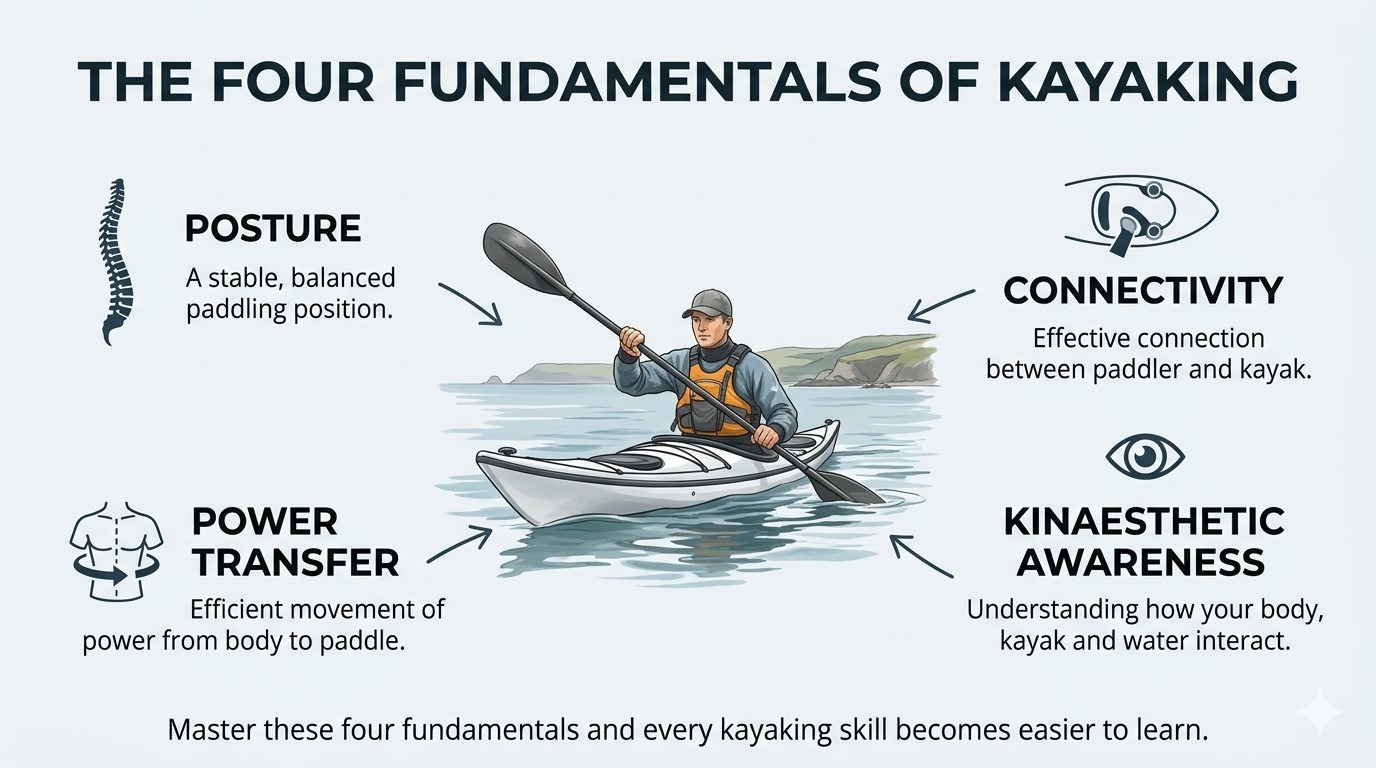
The Four Fundamentals of Sea Kayaking
Why do some paddlers seem to move effortlessly through the water while others struggle despite being fit and determined?
The answer usually isn’t strength. It’s the mastery of four fundamental skills that underpin every aspect of sea kayaking. Whether you’re learning your first forward stroke or preparing for an open-water crossing, these four fundamentals form the foundation upon which every other skill is built.
The four fundamentals of sea kayaking are;
- Good Posture
- Transfer of Power
- Connectivity
- Kinaesthetic Awareness
- Flexibility (The Fifth Fundamental?)
Want Help Improving Your Sea Kayaking Technique?
Understanding good technique is one thing. Feeling it happen in a kayak is something else entirely.
At Mayberry Kayaking, the four fundamentals form the foundation of every coaching session, whether you’re a complete beginner taking your first strokes or an experienced paddler preparing for more challenging journeys.
Interested in improving your paddling?
Explore our beginner and improver sea kayaking courses in Pembrokeshire.
1. Good Posture
Good posture is the foundation upon which all other kayaking skills are built.
A paddler with good posture is balanced, relaxed and able to move efficiently. A paddler with poor posture often struggles to generate power, maintain comfort and respond effectively to changing conditions.
When we talk about posture, we are not talking about sitting rigidly upright. Instead, we are looking for a natural, athletic position that allows the body to move freely and efficiently.
Why It Matters
Good posture helps you:
- Paddle more efficiently
- Reduce fatigue
- Improve balance and stability
- Generate more power with less effort
- Respond more effectively to waves and rough water
Common Mistakes
- Slouching through the lower back
- Leaning backwards against the backrest
- Looking down at the kayak
- Gripping the paddle too tightly
- Sitting asymmetrically in the cockpit
How to Improve It
Start by becoming aware of how you sit in the kayak. A slight adjustment in posture can often make an immediate difference to comfort and efficiency.
For a deeper look at this topic, read our article on The Importance of Good Posture in a Kayak.
2. Transfer of Power
Many paddlers assume propulsion comes primarily from the arms. In reality, the strongest muscles in the body are found in the legs, hips and torso.
Effective paddling involves transferring power from these larger muscle groups through the body and into the paddle.
When this transfer is efficient, paddling becomes smoother, more powerful and less tiring.
Why It Matters
Effective power transfer helps you:
- Paddle further with less effort
- Increase boat speed
- Improve efficiency in headwinds and tides
- Reduce strain on the shoulders and arms
Common Mistakes
- Pulling primarily with the arms
- Little or no torso rotation
- Poor connection with footrests
- Collapsing posture during the stroke
How to Improve It
Focus on rotating through the torso and driving gently with the feet. The paddle should become the final link in a chain that starts with the larger muscles of the body.
Learn more in Power of Transfer in a Kayak.
3. Connectivity
Connectivity describes the relationship between paddler and kayak.
A sea kayak performs best when it becomes an extension of the paddler’s body. This requires appropriate contact with the kayak through the feet, knees, hips and seat.
Without connectivity, control becomes less precise and many techniques become more difficult to learn.
Why It Matters
Good connectivity helps you:
- Control the kayak more accurately
- Improve edging and turning
- Increase stability
- Transfer power more effectively
- Feel more confident in rougher water
Common Mistakes
- Loose contact with knee braces
- Feet not engaging the footrests
- Overly large cockpit fit
- Passive sitting rather than active engagement
How to Improve It
Think about how the kayak feels beneath you. Can you feel subtle movements through your hips and legs? Can you influence the kayak without relying solely on the paddle?
Read more in Get Connected to Your Kayak.
4. Kinaesthetic Awareness
Kinaesthetic awareness is perhaps the least understood of the four fundamentals, yet it underpins all skill development.
It is your ability to sense what your body, kayak and the water are doing at any given moment.
The more awareness you develop, the faster you learn and the more effectively you can adapt to changing conditions.
Why It Matters
Strong kinaesthetic awareness helps you:
- Learn new skills more quickly
- Improve balance
- Recognise mistakes earlier
- Adapt to changing sea conditions
- Develop confidence through understanding rather than guesswork
Common Mistakes
- Focusing only on the paddle
- Ignoring feedback from the kayak
- Rushing learning without reflection
- Trying to copy movements without understanding how they feel
How to Improve It
Slow down occasionally. Pay attention to how movements feel rather than simply whether they succeed or fail. The most effective paddlers are often the most observant.
Explore this further in What is Kinaesthetic Awareness to a Kayaker?
Is Flexibility the Fifth Fundamental?
While flexibility is not one of the original four fundamentals, it plays an important supporting role.
Good flexibility allows paddlers to maintain posture, rotate effectively and move comfortably within the kayak.
A lack of flexibility can limit the development of all four fundamentals.
Learn more in Flexibility for Kayakers.
Why These Fundamentals Matter
At Mayberry Kayaking, these four fundamentals form the basis of every coaching session.
Whether teaching complete beginners on their first sea kayaking experience or helping experienced paddlers refine advanced techniques, we continually return to these same foundations.
The reason is simple: when the fundamentals improve, everything else improves with them.
Forward paddling becomes more efficient.
Turning becomes easier.
Bracing becomes more reliable.
Confidence grows because skills are built on solid foundations rather than luck.
Frequently Asked Questions
What are the four fundamentals of sea kayaking?
The four fundamentals are posture, transfer of power, connectivity and kinaesthetic awareness. Together they provide the foundation for efficient and effective paddling.
Why is posture important in kayaking?
Good posture improves comfort, balance, power generation and paddling efficiency while reducing fatigue.
What is connectivity in a kayak?
Connectivity is the relationship between paddler and kayak. Good connectivity allows more precise control and better transfer of power.
What is kinaesthetic awareness?
Kinaesthetic awareness is the ability to sense how your body, kayak and the water interact. It is a key factor in learning and improving paddling skills.
Can beginners improve all four fundamentals?
Yes. In fact, beginners often benefit most from focusing on the fundamentals early because good habits are easier to develop than bad habits are to correct.
Is flexibility important for sea kayaking?
Yes. While flexibility is not one of the four fundamentals, it supports posture, movement and power transfer within the kayak.
Ready to Improve Your Sea Kayaking?
Reading about technique is valuable, but experiencing it on the water is where real progress happens.
Whether you’re completely new to sea kayaking or looking to refine your existing skills, our courses in Pembrokeshire are designed to help you build strong foundations that will benefit every aspect of your paddling.
Because every stroke, every turn and every successful journey begins with the fundamentals.