Irish Sea Kayak Crossing
A 45-nautical-mile open water journey between Ireland and Wales
Crossing the Irish Sea in a sea kayak is not a casual undertaking.
At approximately 45 nautical miles (around 55 miles on the chart and typically recording 91–92 km on GPS), the route across the St.George’s Channel between Rosslare and Whitesands Bay requires more than fitness. It demands planning, disciplined pacing, tidal understanding, and the ability to make clear decisions long before fatigue sets in.
Over the past decade I’ve been involved in three crossings — two from Ireland to Wales, and one in the opposite direction late in the season. Each was unsupported. Each required careful judgement. And each reinforced the same lesson:
On long crossings, the outcome is decided before you launch.
Planning an Irish Sea Kayak Crossing
None of these journeys were supported.
The day before departure, we left a detailed passage plan with the coastguard including:
- Planned departure time
- Intended bearing
- Expected hourly position
- Estimated arrival time
- Contingency information
Once on the water, the focus shifts to execution rather than improvisation. The planning is what allows the day itself to remain calm.
A crossing like this is rarely about speed. It is about maintaining rhythm, nutrition, hydration, and mental clarity over 12–15 hours of exposure.
The First Crossing: Judgement in Marginal Conditions
The first crossing began with a short chop and almost no wind. The forecast suggested improvement, and that was enough.
Before launching, I had set a mental checkpoint: five hours.
If conditions deteriorated or felt wrong before that point, we would turn back. After five hours, the mathematics change. Continuing forward becomes comparable in distance to returning.
That decision point mattered.
The sea never became uncomfortable, but it wasn’t effortless either. Tide management and boat speed required steady attention. Mid-crossing, a pod of dolphins surfaced alongside us — a brief moment of lightness in an otherwise methodical day.
Landing at Whitesands after more than thirteen hours felt measured rather than dramatic. The satisfaction came not from heroics, but from having made sensible decisions consistently throughout the day.
That distinction — between confidence and competence — becomes very real on open water. I’ve written more about the difference between confidence vs competence in sea kayaking, and why the two are not the same.
The Second Crossing: Mirror Calm
The second crossing could not have been more different.
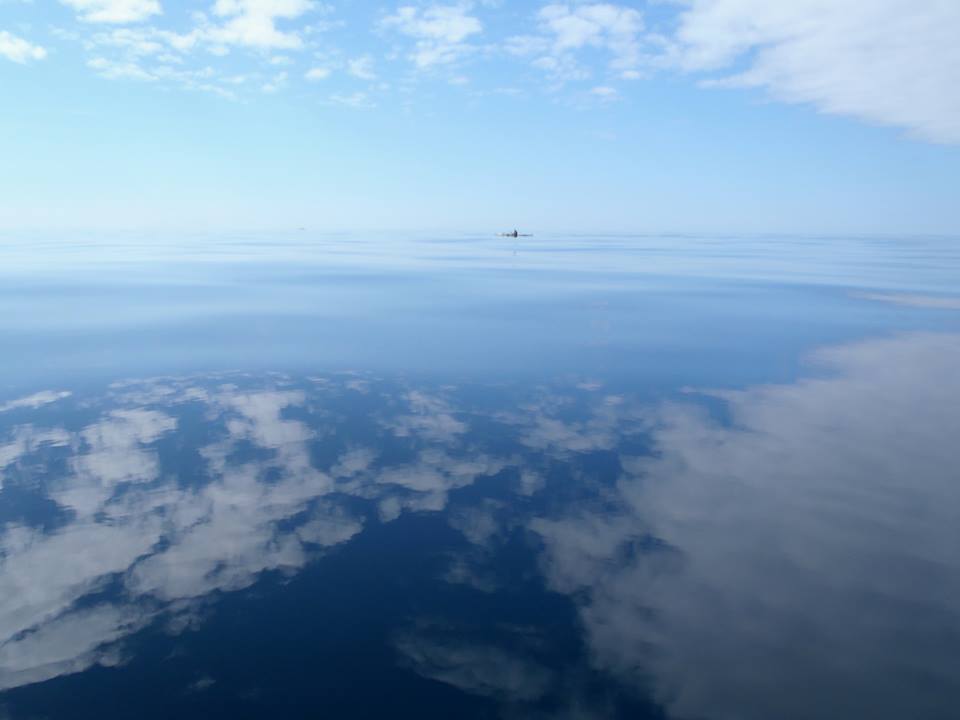
From launch to landfall, the Irish Sea was mirror smooth. Sea and sky blended into a single horizon line. At times it was difficult to tell where one ended and the other began.
There was almost no wind. No visible texture on the water. Just long, quiet miles.
These are rare days. They reward patience in waiting for the right weather window. They also remind you that preparation is what makes calm conditions enjoyable rather than intimidating.
Even in flat water, the same hourly discipline applied:
- Position checks
- Fuel breaks
- Maintaining rhythm
- Energy management
Calm does not remove the need for structure.
The Third Crossing: Wales to Ireland, Late Season
The most committing crossing went the opposite direction — from Whitesands to Rosslare — only ten days before the equinox.
We launched into complete darkness.
For the first three hours, there was no visible horizon. Crossing the Bishops and Clerks at full ebb on one of the biggest tides of the year required precision. Although there was no wind, there was up to one metre of swell during the early hours.
Darkness alters perception. It sharpens focus.
Without visual reference points, navigation becomes entirely compass-led and tide-aware. There is no room for vague bearings or “close enough” thinking.
By daylight, the swell had settled, and the crossing unfolded steadily toward Ireland. But those first hours reinforced something important:
Conditions don’t need to look dramatic to demand respect.
Tides, Decision Points and Exposure
An Irish Sea kayak crossing is shaped primarily by tidal planning.
Wind matters, of course. Swell matters. But tidal timing determines whether you are working with the sea or quietly fighting it.
Decision-making happens in layers:
- Selecting the departure window
- Setting a realistic average speed
- Defining turnaround points before launch
- Monitoring drift against bearing
- Conserving physical output for the final third
Long before fatigue appears, judgement is already at work.
It’s the same principle that applies on shorter coastal journeys — knowing when not to launch, adjusting for tide changes, recognising subtle warning signs.
I explore that further in this article on when not to go sea kayaking, particularly how small decisions early can prevent bigger problems later.
Physical Demands
Shoulders and lower back fatigue are inevitable after 13–14 hours.
However, the physical strain is manageable when pacing is disciplined. The greater challenge is maintaining clarity late in the day, when minor navigational corrections feel less significant than they are.
Nutrition is simple and consistent. Small amounts, regularly. Hydration monitored hourly. Nothing complicated.
The aim is to avoid spikes — in effort, emotion, or energy.
Is an Irish Sea Kayak Crossing for Everyone?
No.
These crossings were undertaken with people I know and trust, with experience appropriate to the undertaking. I led each trip, and I would only consider repeating such a journey with paddlers whose judgement and consistency I already understood.
Open water crossings of this scale are not something I currently offer commercially.
They sit in a different category — one built on shared experience rather than transaction.
However, the judgement required for journeys like this is developed in smaller steps: tidal awareness, route planning, energy management, and the ability to assess conditions honestly.
Those skills are transferable, whether the journey is five miles or fifty.
If you’re interested in building that foundation, you can explore our sea kayaking courses in Pembrokeshire here.
Irish Sea Kayak Crossing – Frequently Asked Questions
How far is the Irish Sea kayak crossing?
The route between Rosslare and Whitesands Bay is approximately 45 nautical miles (around 55 miles on the chart), typically recording 91–92 kilometres on GPS depending on tidal influence.
How long does it take to kayak across the Irish Sea?
Most crossings take between 12 and 14 hours depending on conditions, tidal timing, and average boat speed.
What makes this crossing challenging?
Tidal streams, open water exposure, mental endurance, and the requirement for sustained decision-making over many hours.
Is it guided?
No. These crossings were unsupported and undertaken privately with experienced paddlers.
Video: Irish Sea Kayak Crossings
You can watch footage from the 2013 Irish Sea kayak crossing here.
And a video of sea kayaking across the Irish Sea in 2023 here.
Each shows different conditions, reinforcing the same principle: the sea rewards preparation more than optimism.