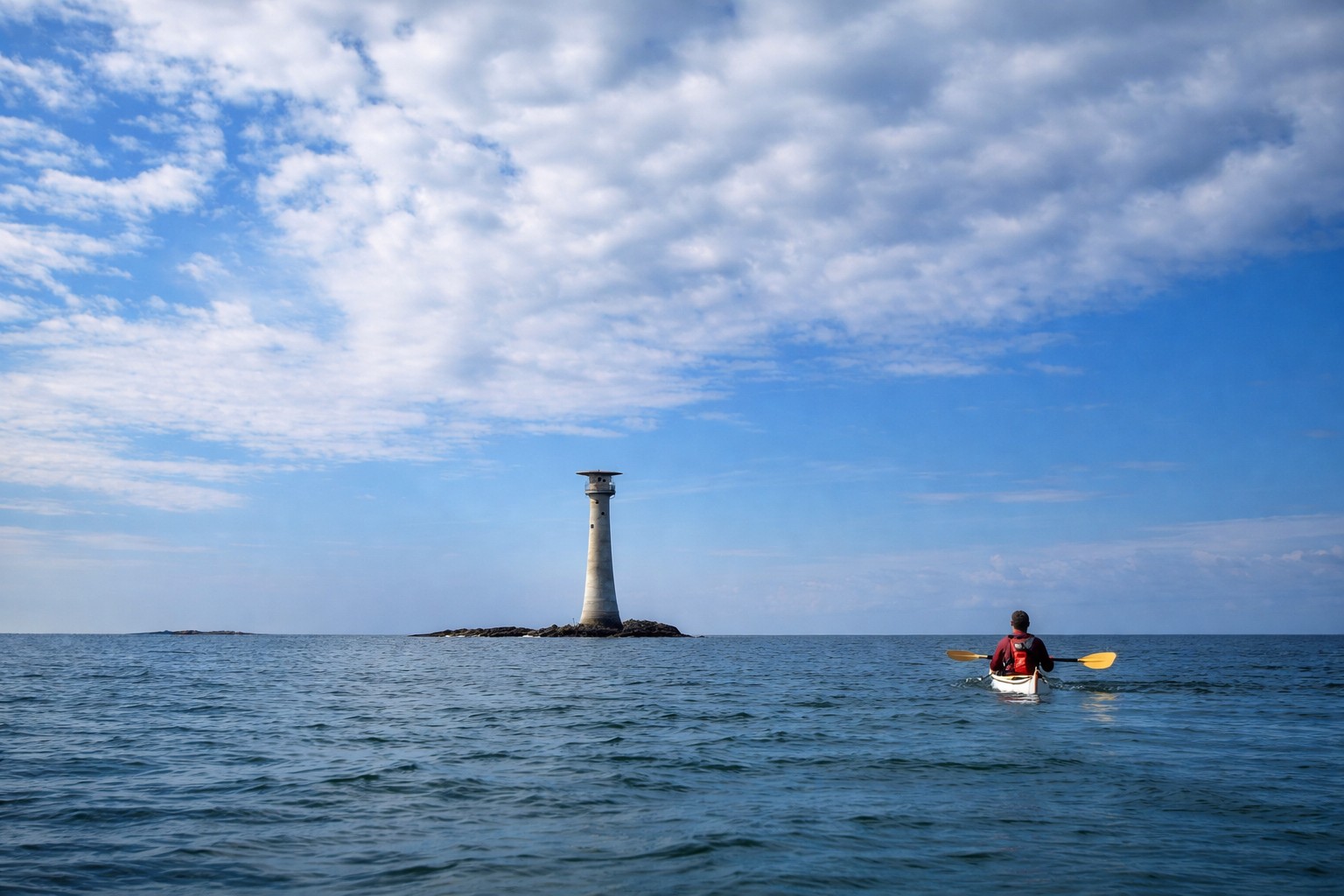
Kayaking to the Smalls Lighthouse
An offshore sea kayak journey beyond the Pembrokeshire coast
Kayaking to the Smalls Lighthouse off the Pembrokeshire coast is a serious open-water commitment. Lying approximately 20 miles offshore, the lighthouse sits beyond immediate land shelter and requires careful tidal planning, weather awareness and disciplined pacing.
This is not a casual coastal paddle. It is a full offshore journey.
A Small Target in a Big Sea
I had never seen a photograph of a sea kayak at the Smalls Lighthouse — the farthest of the Pembrokeshire islands from the mainland — so sea kayaking to the Smalls had been on my “to do” list for some time.
At 22 miles offshore and perhaps only 50 square metres visible at high water, it is a surprisingly small target to find.
Getting there would involve navigating the infamous Bishops and Clerks as well as managing tides of up to four knots around the Smalls themselves. Only Stuart Yendle volunteered to join me. He had ambitions of crossing the Irish Sea by sea kayak, so this felt like a fitting warm-up.
We later heard that the first successful sea kayaking trip to the Smalls Lighthouse was in 1984, led by Nigel Foster. In the years that followed there were several unsuccessful attempts. As far as we know, we were only the second party to reach it by sea kayak.
An Early Start from Whitesands
We were up early on Friday morning, needing to catch the tide from St. David’s Head at 6am.
The street lights outside my house were still off when we left, and the sun was still sleeping when we arrived at Whitesands. Meanwhile, the Bishops and Clerks were rising mysteriously from the misty horizon, and the beam from South Bishop swept its arc every five seconds.
It was a beautiful morning to begin something committing.
After packing the kayaks carefully, we confirmed our plan with the coastguard and left the bay. Shortly afterwards, the sun lifted behind us above St. David’s Head.
Shearwaters circled as we paddled. They leave Skomer during the day to avoid the black-backed gulls, and I often see them on longer trips. Over time, I have come to think of them as quiet companions. It is moments like that which remind me why I love sea kayaking so much.
Through the Bishops and Clerks
We reached South Bishop Lighthouse within the hour, assisted by a three-knot tide that carried us smoothly through the islands.
By our first break, St. David’s Head already felt distant. Although we were expecting an easterly force 3–4 later in the day, there was no sign of it yet. The sea was almost mirror smooth.
By our second break we were properly offshore. The mainland was fading, and the Smalls Lighthouse was only just visible on the horizon.
A couple of dolphins passed us. Predictably, they did not resurface once the cameras were ready. Porpoise also made a brief appearance during the crossing.
Gradually, the lighthouse began to show colour rather than silhouette. At that point we knew we would hit our target cleanly. Only then did we appreciate how small the reef truly was.
Another half hour brought us alongside.
At the Smalls Lighthouse
The reef was covered in seals and gulls, none of whom appeared concerned by our arrival. We had no intention of landing where seals were resting. This is their home; we are guests.
However, around the eastern side we found steps and no seals, so we took the opportunity to stretch our legs briefly.
As we prepared to launch again, we heard a dive boat approaching. Once afloat, someone on board began waving frantically. We paddled across.
It turned out to be someone I knew.
Stuart, I think, was more surprised to see anyone at all this far offshore than he was that I recognised them.
Offshore Exposure
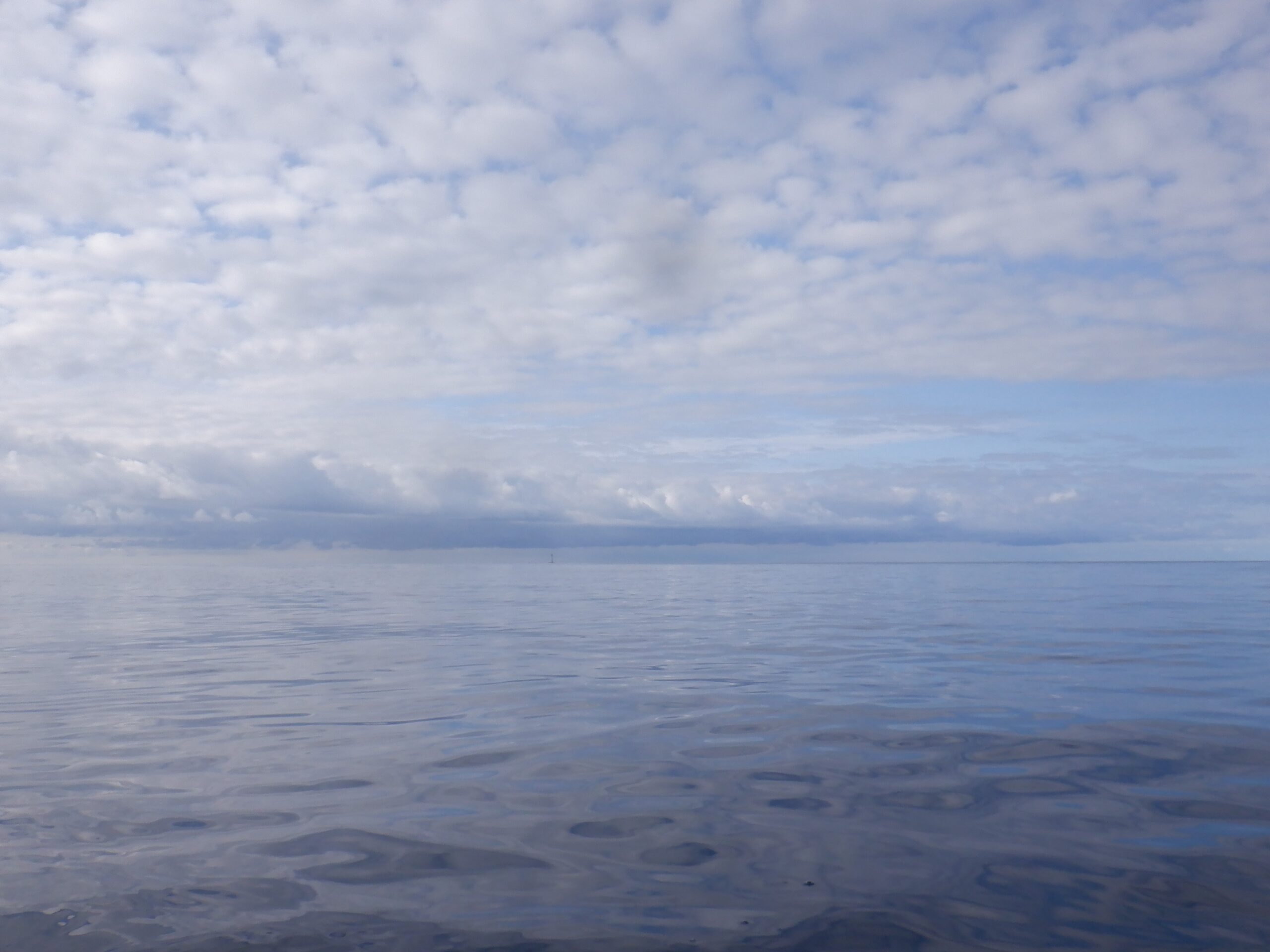
Swell behaves differently offshore, and even moderate movement feels amplified without land reference. This is where preparation matters more than ambition.
That distinction between optimism and experience becomes clearer the further you paddle from shelter. I have written more about that difference in confidence vs competence in sea kayaking, because offshore journeys reveal it quickly.
The Smalls are not difficult in a technical sense. However, they are committing. Therefore, timing, bearing and pacing matter more than power.
The Return to the Mainland
Heading back to the Pembrokeshire mainland was more complex than the outward leg.
We were leaving at the start of the flood. By the time we would reach the Bishops and Clerks again, we would be catching the last of the tide there. Additionally, the forecast easterly wind arrived — now directly in our faces.
Progress slowed noticeably. The wind reduced our usual speed by roughly twenty-five percent.
It seemed to take an age for Ramsey Island to appear. Fortunately, after two hours the wind eased again.
We reached South Bishop an hour before the mainland tide would turn against us. Conditions through the Bishops and Clerks were manageable, and we threaded our way back with steady focus.
Back at Whitesands
Once safely inside Whitesands Bay, we called in to the coastguard.
The beach was full of tourists, occupying almost every inch of sand. To our right, a creek boat paddler was working hard to get our attention. It was Martyn. He had heard us calling in on the radio and launched to meet us.
Thanks to his timing, we finally had a photograph of the two of us together.
We had paddled 69.4km.
We had been gone for over 11 hours.
Our average speed was 6.2km/h, with a maximum of 14.5km/h.
As we carried the kayaks up the beach, we felt slightly overdressed for the afternoon crowd.
Reflections
I believe coaches should always be a kayaker first and a coach second.
With so much variety along this coastline, sea kayaking in Pembrokeshire is never dull. However, it only remains meaningful if I can still take occasional days like this — not to instruct, but simply to paddle with good company.
Sea kayaking to the Smalls Lighthouse was one of those days.
If you are building toward longer offshore journeys, progression happens step by step. Choosing conditions carefully, understanding tide, and knowing when not to launch are all part of that development. I explore that further in when not to go sea kayaking.
For those wanting to develop those skills in a structured way, our sea kayaking courses in Pembrokeshire provide the foundation.
Featured in Canoe Focus Magazine
This journey was later featured in Canoe Focus Magazine.
👉 Canoe Focus Magazine article about the Smalls Lighthouse crossing
Video: Smalls Lighthouse and Grassholm
You can watch footage from a sceond trip to the Smalls Lighthouse inlcuding Grassholm here.